
QR Code for Cleaning Business Growth
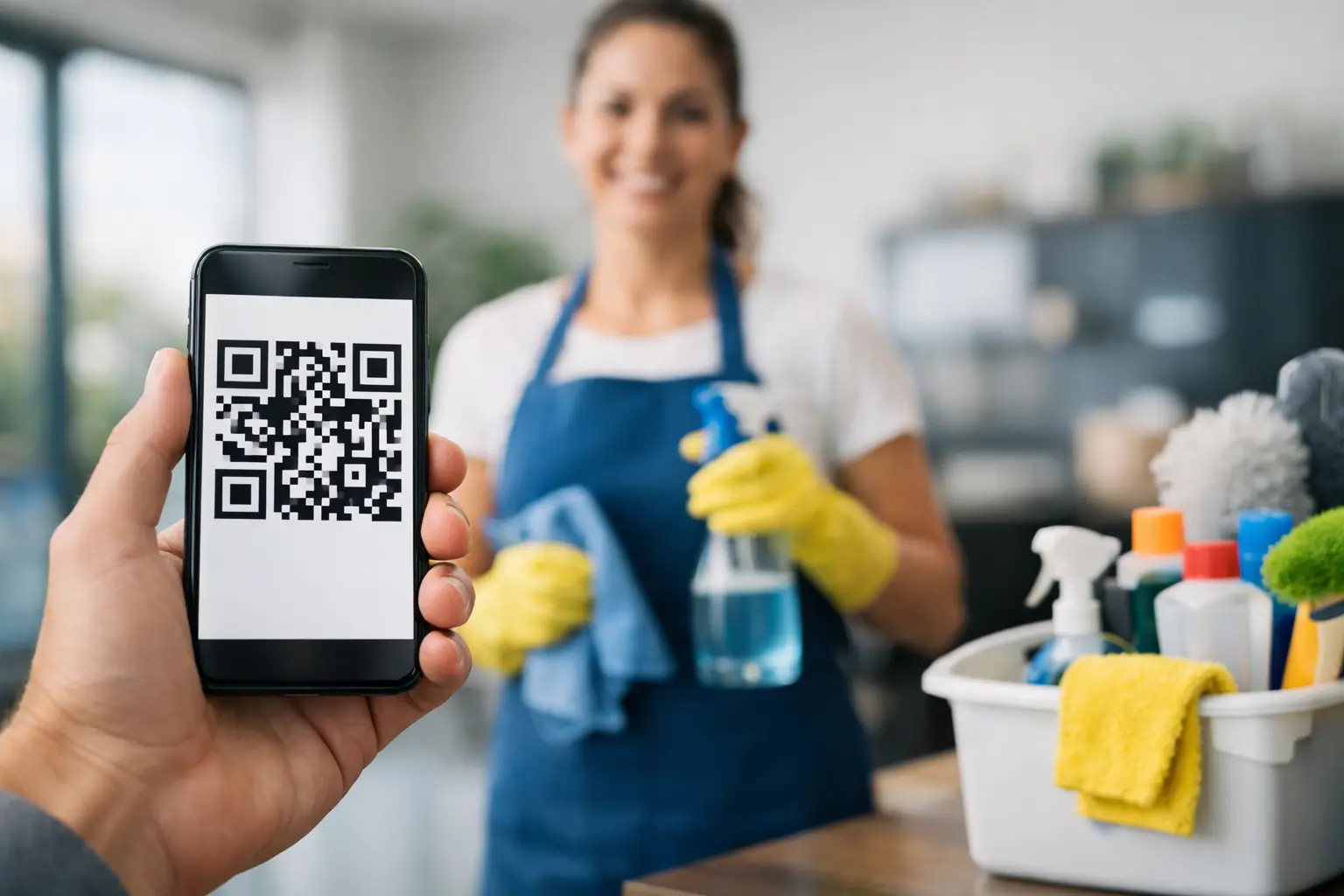
A flyer on a mailbox, a business card at checkout, and a magnet on the side of your car can all do the same job - or waste the same money. The difference is what happens after someone sees them. A qr code for cleaning business marketing gives people one fast way to reach you, ask for a quote, and book without hunting for your number or typing in a web address.
For solo cleaners and small teams, that matters more than people think. Most lost leads are not about price. They are about friction. A customer means to call later, forgets, and hires the next cleaner who was easier to reach. If your marketing is already out in the world, a QR code helps it work harder without adding another complicated system to manage.
Why a qr code for cleaning business owners works
A QR code shortens the distance between interest and action. Someone sees your service, scans with their phone camera, and lands on a page where they can message you, call you, or request a quote. That is a lot better than hoping they save your number and remember to follow up after work.
Cleaning businesses are especially well suited for this because so much growth comes from local, offline visibility. Yard signs after a deep clean, cards left with realtors, apartment move-out flyers, and referral handouts all depend on quick response. A QR code turns those materials into lead capture tools instead of just reminders.
It also helps with bilingual customers. In many markets, your next client may prefer Spanish, English, or both. If the page behind the code makes it easy for them to understand your services and contact you in the language they are most comfortable with, you remove one more reason for them to move on.
Where to use a qr code for cleaning business marketing
The best place for a QR code is anywhere a customer already has a few seconds to look at your business. That includes business cards, door hangers, flyers, car magnets, invoices, leave-behind cards, and signs outside a property you just cleaned.
There is some nuance here. A QR code on a moving car is less useful than one on a parked vehicle. A tiny code on a cluttered flyer may not get scanned at all. And if the customer has to stand far away from the sign, the code needs to be large enough to scan quickly. Good placement matters as much as the code itself.
Think about customer intent. A past customer getting an invoice might scan to rebook recurring service. A property manager seeing your card may scan to request a commercial quote. A neighbor walking by your yard sign may just want pricing. One code can work for all of them if the page they land on makes the next step obvious.
What should happen after the scan
This is where a lot of cleaning businesses get it wrong. They generate a code, point it to a social profile or a generic homepage, and assume the job is done. But a scan is not the goal. A lead is the goal.
When someone scans your QR code, they should land on a simple page that answers three questions fast: who you are, what cleaning services you offer, and how to contact you right now. If they have to click through multiple pages, wait for slow loading, or guess what to do next, your conversion rate drops.
For most small cleaning companies, the best destination is not a full website with lots of tabs. It is a mobile-friendly business profile with clear service details, photos, service area, and strong call-to-action buttons for quote requests, texting, or calling. If you can capture the lead immediately, you give yourself a real chance to book the job.
If you rely on phone calls, make sure missed calls do not become missed opportunities. If you rely on text, make sure those messages do not sit unanswered while you are cleaning a house. The page behind your QR code should support how you actually run the business, not how a software company thinks you should run it.
How to set up a QR code without making it complicated
The simplest setup is usually the best. Create one destination page that works on mobile, shows your business clearly, and gives customers one or two easy ways to contact you. Then generate a QR code that points to that page and use the same code across your printed materials.
If you are just starting out, do not overbuild this. You do not need a huge website, ten service pages, or a long form that scares people off. You need a fast path from scan to conversation.
A good setup usually includes your business name, services, city or service area, a few trust signals like reviews or photos, and a quote request option. If you offer recurring cleaning, move-out cleaning, or office cleaning, mention those plainly. Customers should know within seconds whether you are the right fit.
This is one place where GigConvert fits naturally for cleaning businesses. Instead of sending people to a traditional website, you can use a public business profile that acts like your web presence, gives you a shareable QR code, and captures leads from flyers, cards, magnets, and direct messages in one place. That approach makes sense if your goal is getting booked, not spending weeks building pages you will never update.
Common mistakes that cost you scans and jobs
The biggest mistake is treating the QR code like the strategy. It is just the bridge. If the destination page is weak or your response time is slow, the code will not save the lead.
Another common problem is poor design. If the code is too small, low contrast, or buried among too much text, people will skip it. If you use it on a flyer, give it room. Add a short line above it like Scan for a fast quote or Scan to book a cleaning. People are more likely to scan when the benefit is clear.
Some businesses also send every scan to the same generic page, even when the customer context is different. That can work, but sometimes it is smarter to use separate QR codes for different campaigns. A realtor handout might go to a move-out cleaning page. A recurring housekeeping flyer might go to a page focused on weekly and biweekly service. It depends on how targeted your marketing is and whether you can manage more than one code.
And then there is follow-up. If someone scans at 2:15 p.m. and you do not answer until the next morning, you may already be out of the running. Fast response is a competitive advantage in cleaning. A QR code helps you catch attention, but your system still has to catch the lead.
How a QR code helps you track what is working
Printed marketing is often hard to measure. You hand out cards, leave flyers, or wrap your vehicle, and then you guess. A QR code gives you a cleaner line between the marketing piece and the customer action.
If you use different codes for different channels, you can see what actually brings in leads. Maybe your apartment complex flyers outperform your business cards. Maybe your yard signs get more scans than your car magnet. That kind of visibility helps you stop wasting money on materials that look nice but do not produce jobs.
You do not need perfect attribution to make better decisions. Even a basic understanding of where scans and inquiries come from can help you double down on the channels that book work. For a small operator, that is often more valuable than a fancy report.
Is a QR code enough on its own?
Usually, no. A QR code is a strong tool, but it works best as part of a simple lead capture system. You still need a clear offer, a trustworthy business presence, and a way to respond quickly.
If your schedule is packed and you only want higher-value jobs, the page behind your code should help qualify leads. If you want more recurring residential clients, it should make ongoing service easy to request. If most of your customers text first, lean into that. The right setup depends on how you sell and what kinds of jobs you want more of.
That is the real value of a qr code for cleaning business growth. It does not replace your reputation, your service quality, or your follow-up. It removes one small but expensive barrier between local attention and booked work.
If your cards, flyers, and signs are already out there, give people the fastest next step possible. The easier you make it to reach you, the more often your marketing gets a second chance to become a job.